
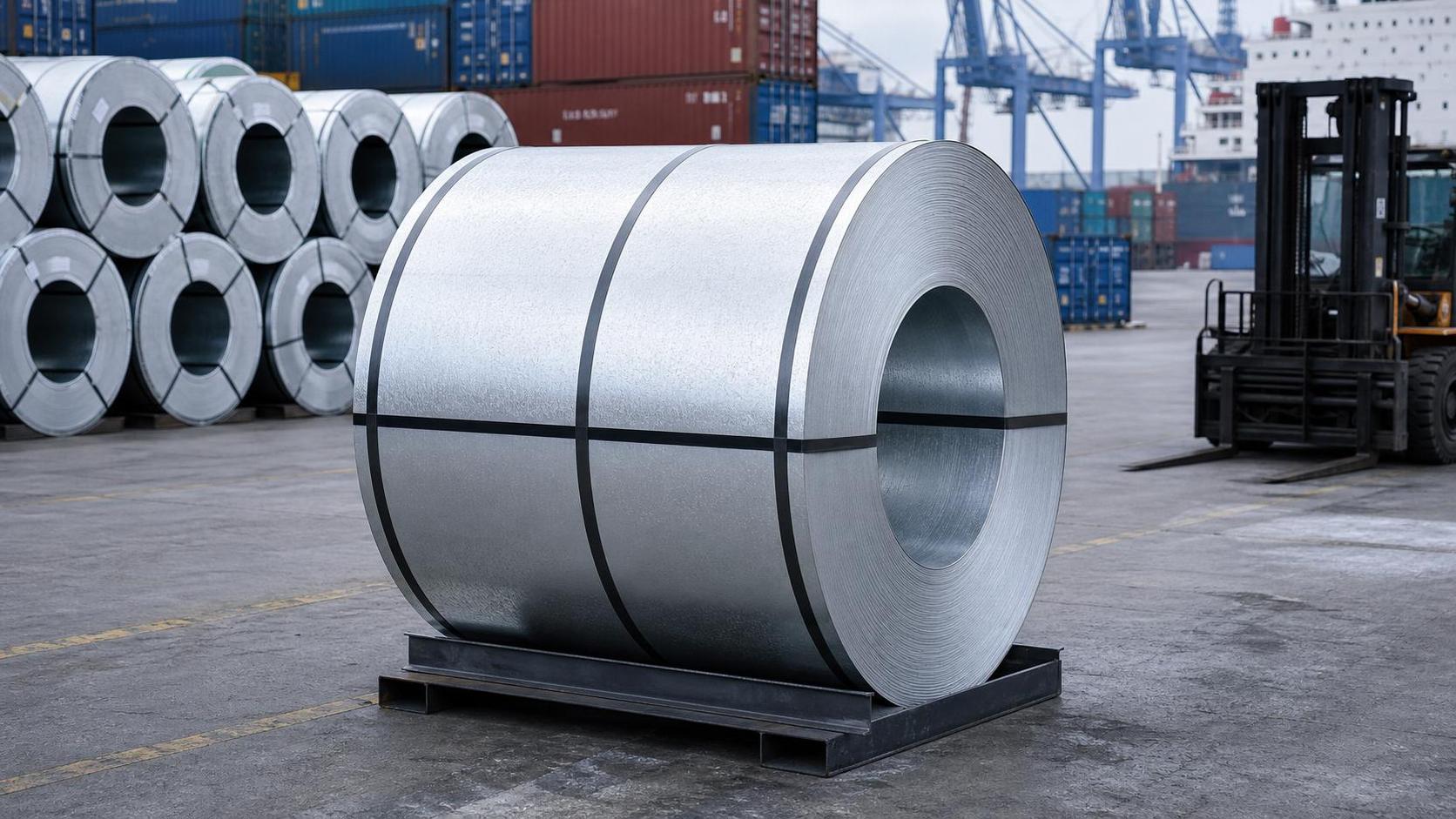
In 2026, the market for Galvanized Steel Coil is likely to be less predictable than many buyers prefer. Prices will respond not only to zinc and hot-rolled coil costs, but also to freight pressure, policy shifts, and tighter regional supply. For companies managing budgets, delivery schedules, and long project cycles, reading these signals early matters because galvanized steel often sits at the intersection of cost control, corrosion performance, and procurement reliability.
Why Galvanized Steel Coil remains a strategic material
Galvanized Steel Coil is carbon steel coated with zinc to improve corrosion resistance. That simple definition explains its wide use, but not its business importance.
In practice, it supports roofing systems, wall panels, ducting, appliance shells, automotive parts, cable trays, storage equipment, and light industrial structures.
The appeal is clear. It offers a balance between mechanical strength, surface durability, forming performance, and cost compared with many alternative metals.
That balance becomes more important when projects must last longer, operate outdoors, or meet tighter maintenance targets without pushing material budgets too far.
What is likely to shape price trends in 2026
The price of Galvanized Steel Coil does not move in isolation. It follows a chain of upstream and downstream factors, and several of them may remain volatile in 2026.
Raw materials will still set the floor
Zinc prices are one of the most direct cost drivers. When zinc supply tightens or energy costs rise, galvanized products usually react quickly.
Hot-rolled coil is the other major base input. If steelmaking margins compress or mills reduce output, substrate costs can rise even before coating is applied.
Energy and environmental costs will matter more
Coating lines depend on stable power and gas input. Environmental compliance, emissions controls, and production restrictions can also change effective capacity.
This means buyers may face price increases even when end-use demand looks only moderate on the surface.
Trade policy can quickly change landed cost
Anti-dumping actions, safeguard measures, and tariff changes can reshape sourcing routes in a short time. A seemingly low-cost offer may become less attractive after duties, port delays, or customs changes.
For imported or export-linked Galvanized Steel Coil, trade policy is no longer a background issue. It is a direct pricing variable.
Where supply risks may become more visible
Supply risk in 2026 is unlikely to come from a single global shortage. More often, it will appear as uneven availability across grades, coatings, lead times, and shipping windows.
The most important point is that physical availability and quoted price should be judged together. Low quotes are less useful when delivery certainty is weak.
How demand from key sectors may influence the market
Galvanized Steel Coil serves many industries, and each affects demand in a different way. Construction usually drives volume, while automotive and machinery can drive higher specification requirements.
Infrastructure and power projects often favor reliable supply and standardized quality over purely opportunistic pricing. That tends to support stable demand even in uneven economic periods.
Appliance, ventilation, bridge-related fabrication, and petrochemical support structures add another layer. These segments may require strict surface quality, forming behavior, or standard compliance.
When several sectors recover at the same time, mills may prioritize larger contracts or more profitable specifications. That is when spot buyers often feel the tightness first.
The sourcing question is no longer only about price
In a volatile year, the right Galvanized Steel Coil decision depends on total procurement quality. That includes consistency, standards, testing, conversion capability, and transport efficiency.
This is where supplier background becomes relevant. A company positioned in Tianjin benefits from proximity to one of northern China’s major industrial and maritime hubs.
Tianjin Runjin Metal Materials Co., Ltd. operates in this environment, supported by access to the Beijing-Tianjin-Hebei industrial network and Tianjin Port logistics.
That matters for buyers comparing inland delays, export handling efficiency, and the ability to coordinate different steel categories in one procurement plan.
Its portfolio spans carbon steel, galvanized steel, and stainless steel in plates, pipes, coils, and profiles. For projects involving multiple materials, this can reduce coordination risk.
Just as important, advanced equipment and testing capability help address a common problem in galvanized procurement: a product can match nominal dimensions yet still fail in performance consistency.
Why verification capability matters
Mechanical property testing, flaw detection, hydrostatic testing, metallographic analysis, and carbon-sulfur analysis are not marketing details. They reduce uncertainty.
For Galvanized Steel Coil, buyers often need confidence in substrate quality, coating behavior, and conformity to GB, ASTM, JIS, or DIN requirements.
When downstream fabrication includes bending, stamping, welding, or outdoor exposure, poor consistency can become much more expensive than a slightly higher unit price.
Practical signals worth tracking before placing orders
A stronger buying decision usually comes from watching a small group of signals regularly, rather than reacting to one weekly quote.
- Monitor zinc and hot-rolled coil trends together, because one without the other gives an incomplete cost picture.
- Track lead time changes by specification, especially coating weight, thickness tolerance, and surface treatment.
- Review freight and port conditions early when delivery windows affect installation or production sequencing.
- Confirm standards and testing documents before price comparison, not after supplier selection.
- Evaluate whether split sourcing or framework agreements offer better protection than spot purchasing alone.
These steps are especially useful when the same project depends on multiple steel products and any delay in one item can slow the entire schedule.
A workable approach for 2026 procurement planning
The 2026 market does not necessarily call for aggressive buying. It calls for clearer judgment.
A practical starting point is to separate strategic volume from flexible volume. Lock in the portion tied to firm schedules, then keep room for market adjustment.
It also helps to define acceptable substitutes in advance, such as nearby gauge ranges, coating classes, or equivalent standards where project rules allow.
For Galvanized Steel Coil, procurement resilience often comes from preparation, not prediction. The better the specification discipline and supplier visibility, the lower the exposure to sudden market swings.
As pricing and supply conditions evolve through 2026, the most useful next step is to build a short review framework: cost drivers, delivery risk, standard compliance, and logistics readiness. With that structure in place, comparisons become more reliable and sourcing decisions become easier to defend.
- Last One:How to Choose Stainless Steel Plate for Corrosion-Critical UseJun 25, 2026
- Next Article:No more articles
Message
Leave A Message
If you are interested in our products and want to know more details, please leave a message here, we will reply you as soon as we can.